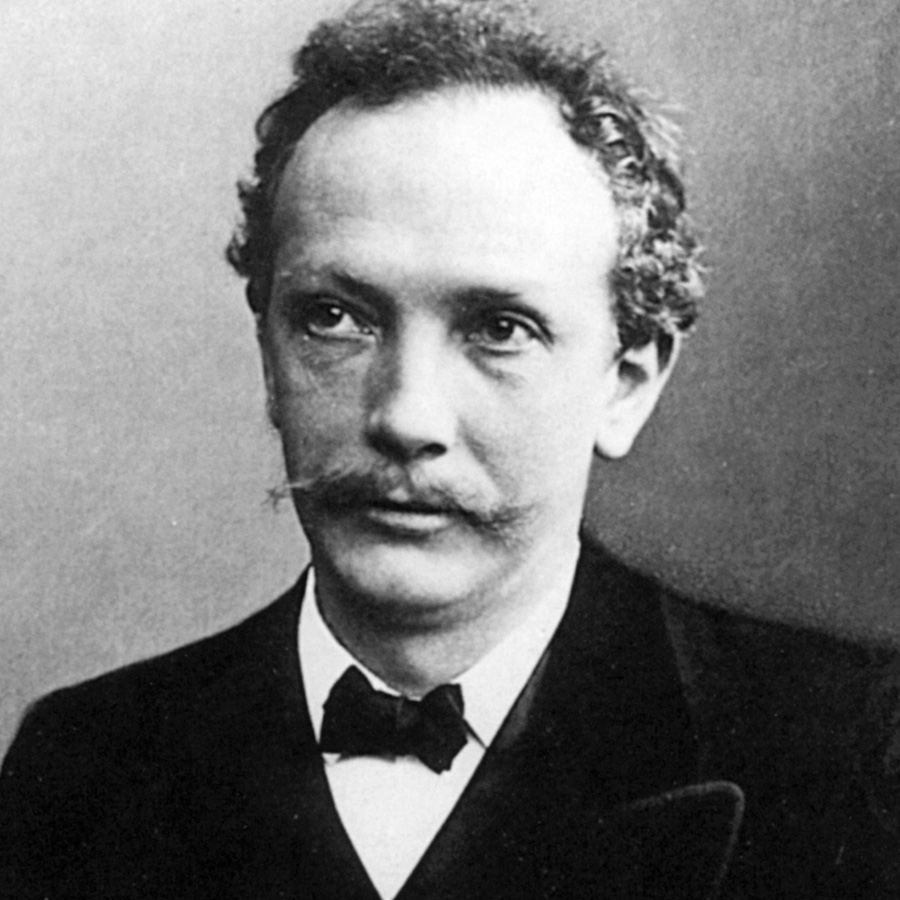
Born in Munich, Germany, in 1864, Richard Strauss was a leading composer of the modern orchestra and a master of composing for the human voice. The son of an eminent horn player, Franz Strauss, he was trained in music at home from the age of 4 and later attended the University of Munich.
His early works were strongly influenced by the classical and romantic masters, leading to the creation of Burleske (1885) for piano and orchestra and a symphonic fantasy Aus Italien (1887). Between 1887 to 1904, Strauss developed the symphonic poem, making a notable contribution to the repertory of program music.
With the premiere of his tone poem, Don Juan (1888), he became known as a leading progressive composer. Other works produced in this period include Macbeth (1890), Death and Transfiguration (1890), Till Eulenspiegel’s Merry Pranks (1895), and Don Quixote (1897).
His compositions from 1904 to 1949 were mostly operas, including Elektra (1909) and Der Rosenkavalier (or The Cavalier of the Rose, 1911). After the production of his first successful opera, Salome (1905), Strauss formed a partnership with the Austrian poet and librettist Hugo von Hofmannsthal. Together, they produced many “Neo-Classical” operas inspired by Classical and Enlightenment ideals related to balance, order, and harmony, including Ariadne auf Naxos (or Ariadne at Naxos, 1916) and Arabella (1933).
Starting at the age of 21, Strauss was a successful conductor of orchestras and director of opera houses in Germany and Austria. He also had an international conducting career, which took him to North and South America as well as most parts of Europe throughout the 1920s.
We are on a mission to bring the highest quality musical experiences to all corners of our community.
Sign up to join our newsletter and receive updates on upcoming events and exclusive discounts.