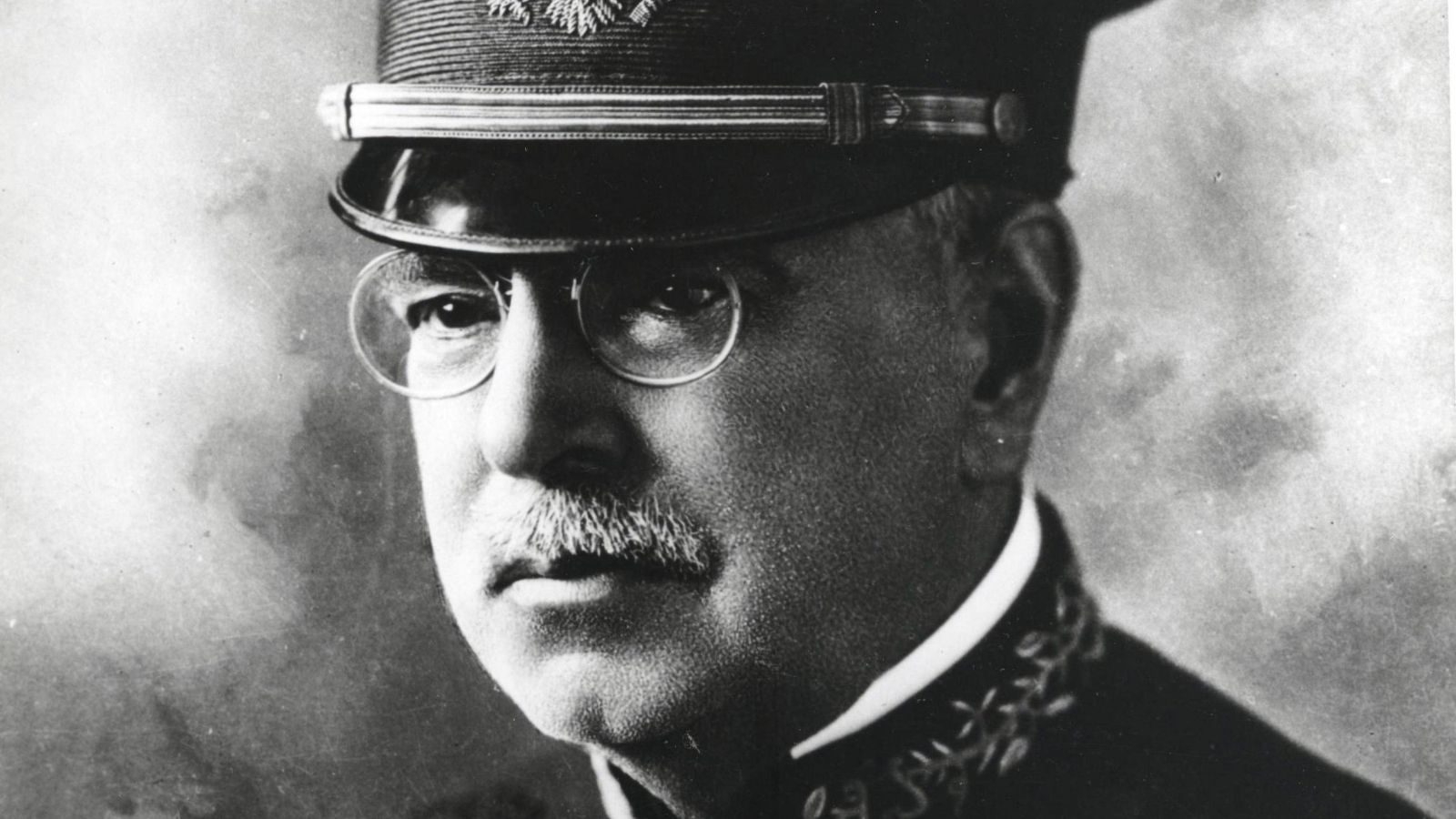
John Philip Sousa (6 November 1854, Washington, D.C. – 6 March 1932, Reading, Pennsylvania) was America’s best known composer and conductor during his lifetime. Highly regarded for his military band marches, Sousa is often called the “The March King” or “American March King”.
Sousa was born the third of 10 children of John Antonio Sousa (born in Spain of Portuguese parents) and Maria Elisabeth Trinkhaus (born in Bavaria). His father played trombone in the U.S. Marine band, so young John grew up around military band music. Sousa started his music education, playing the violin, as a pupil of John Esputa Jr. and G. F. Benkert for harmony and musical composition at the age of six. He was found to have absolute pitch. When Sousa reached the age of 13, his father enlisted him as as an apprentice of the United States Marine Corps. Sousa served his apprenticeship for seven years, until 1875, and apparently learned to play all the wind instruments while also continuing with the violin.
Several years later, Sousa left his apprenticeship to join a theatrical (pit) orchestra where he learned to conduct. He returned to the U.S. Marine Band as its head in 1880, and remained as its conductor until 1892. He organized his own band the year he left the Marine Band. The Sousa Band toured 1892-1931, performing 15,623 concerts in America and abroad. In 1900, his band represented the United States at the Paris Exposition before touring Europe. In Paris, the Sousa Band marched through the streets including the Champs-Élysées to the Arc de Triomphe – one of only eight parades the band marched in over its forty years. Sousa died at the age of 77 on March 6th, 1932 after conducting a rehearsal of the Ringgold Band in Reading, Pennsylvania. The last piece he conducted was “The Stars and Stripes Forever”, his most famous work and the US’s national march.
Sousa wrote 136 independent marches, while a host of other marches and dances have been adapted from his stage works. Despite the genre’s relatively limited structure, Sousa’s marches are highly varied in character. The vast majority are in the quickstep dance style and a third of their titles bear military designations. His earlier marches are best suited for actual marching, while later works are increasingly complex. He also wrote school songs for several American Universities, including Kansas State University, Marquette University, the University of Michigan, and the University of Minnesota.
We are on a mission to bring the highest quality musical experiences to all corners of our community.
Sign up to join our newsletter and receive updates on upcoming events and exclusive discounts.